Showing posts with label Cloud Modernization. Show all posts

Friday, 10 May 2024

Build the foundation for SAP ERP modernization

Build the foundation for SAP ERP modernization

Successful SAP ERP modernization programs begin with clear organizational alignment on wanted outcomes and expected business value, end-to-end scope and roadmap. This alignment is critical to enterprises that run their core operations on SAP ECC for years. It helps them determine where to start their modernization initiatives and how to prioritize, organize and plan to see the value of this investment.

To build this strategic plan, enterprises need a fact base that enables them to move forward with critical SAP S/4HANA-enabled transformation decisions across people, process, enterprise architecture and next-gen technology. 

With hundreds of successful implementations of S/4HANA programs that involved both SAP ERP applications and infrastructure modernization, IBM® has a well-defined approach that is called Rapid Discovery. This approach helps determine the what, why and how for SAP ERP modernization and is infrastructure agnostic. Whether you are running SAP ERP on AIX, IBM i, Linux® or Windows, the approach remains the same. IBM’s team of cross-functional experts uses innovative tools and frameworks to build a transformative foundation composed of six essential ingredients: 

  1. Enterprise Capability Model—Agreement on the business process hierarchy that defines the scope of the ERP implementation while also defining business requirements in the to-be business processes 
  2. Governance Model—Clear structure, framework and operating model for program oversight and implementation including key roles, responsibilities and decision authority 
  3. Business Value—Financial case for change in transformation that quantifies the tangible benefits of the program and compares them to the costs of implementation 
  4. Implementation Roadmap—Clear articulation of key architectural decisions, scope of services, data strategy and implementation roadmap for transformation 
  5. Executive Alignment—Alignment of executives across the business on the purpose, priorities, path forward, responsibilities and business benefits of transformation 
  6. Sustainability Framework—Alignment of sustainable goals into the overall ERP strategy to allow for single source of truth data access for regulatory requirements 

As part of Rapid Discovery, we also help clients work through issues that are related to the following enablers: 

  • Modern Enterprise Architecture—Design the future-state enterprise architecture, including strategic direction for application rationalization and RISE or non-RISE cloud strategy. 
  • Data and Analytics—Determine the current-state realities of data readiness and develop an optimized data and analytics strategy to support and utilize the move to SAP S/4HANA. 
  • Security and Controls—Define the security and controls architecture after reviewing the current maturity levels. 
  • Change management—Uncover and understand the organizational change management opportunities and impacts related to ERP transformation and develop a high-level approach to unlock user adoption and value realization.

This well-defined discovery process for SAP ERP modernization helps you assess your current SAP ERP landscape, define your to-be state and align on business case, operating model and a modern enterprise architecture. If you would like to learn more, join us for the webinar, “Build the foundation for SAP ERP modernization with rapid discovery assessment” where we take a detailed analysis of this process. 

Source: ibm.com

Thursday, 2 March 2023

Will ISO 20022 overcome its delays to unlock huge opportunities?

IBM Exam, IBM Exam Prep, IBM Exam Certification, IBM Career, IBM Jobs, IBM Skills, IBM Prep, IBM Preparation, IBM Tutorial and Materials

For decades, financial institutions and corporations have sought an easy and standard method of exchanging electronic financial messages. MT standards, X.25 and all the EDI formats were supposed to solve deficits in the data and finance reporting space. In 2004, when the first publication of ISO 20022 was released, payments practitioners and industry professionals all had the same thought: What a great idea!


At the time, it made absolute sense to introduce data-rich payments to improve automation, enhance reporting and analytics, improve interoperability and decrease risk through accurate reconciliation and regulatory compliance activities.

By 2018, many wondered why the industry hadn’t widely adopted ISO 20022. Although some countries adopted ISO 20022 for payments systems by 2019, most did not realize the potential of the rich data within streams. That same year, when SWIFT mandated an ISO 20022 rollout for 2021, with richer data than its old MT standard, the industry started investing more heavily in the adoption of ISO 20022. Despite this mandate, the roll-out plan was pushed out to 2022, and again more recently, to the first quarter of 2023.

These delays (and what seems like a reluctance to make ISO 20022 happen in some jurisdictions) led me to wonder, “What’s hindering the global adoption of ISO 20022 and the rich data structures it supports?” The answer may lie in the balance of benefits and costs of adoption.

What is the value of adopting ISO 20022?


Numerous publications on the topic have boasted the benefits of adopting ISO 20022. As a community, payments professionals and practitioners were promised numerous benefits from a processing and payments operations perspective, related to the rich and structured data of ISO 20022:

◉ Ability to transfer more complete and accurate information between banks and other FIs
◉ Higher straight-through processing rates using the rich information
◉ Fewer manual validations from a regulatory compliance perspective
◉ Ability for compliance teams to focus on investigating true hits rather than false positives
◉ No truncated information and no data loss
◉ Little to no limitation on the number of characters travelling with the payment messages
◉ Interoperability between interconnecting core banking systems, market infrastructures and end users
◉ Easier development due to the format’s use of XML, a common language

Theoretically, these ISO 20022 benefits are great. But to understand the big picture, we must address the challenges.

What are the challenges of adopting ISO 20022?


The industry has faced multiple challenges with the adoption of ISO 20022. Timelines are aggressive (though the pressure is largely due to inactivity from an ISO 20022 adoption perspective), and many institutions find themselves with a lack of resources to be able to make the roll-out deadlines. Additionally, ISO 20022 regularly updates its message standard and publishes new versions of message types regularly. How do financial institutions and FinTechs keep up with this fast-paced change? It would benefit adopters to implement a system that can adapt to change easily. FinTechs could develop software that’s made for change to stay ahead of the evolving standard.

Many well-established financial institutions and market infrastructures rely on legacy systems running on an aging infrastructure, which is a challenge the industry needs to overcome. Moreover, these legacy systems speak a language that is not easily compatible with ISO 20022, and the message formats are typically far more stringent than even ISO 20022’s predecessor ISO 15022 (with formats for CHIPS, BACS, CPA005 and ACH, to name a few). These systems were originally developed to process low-value payments at very low cost. Meanwhile adopting ISO 20022 can be very costly for the participants of the payments ecosystem—so how can we argue that the value in adopting ISO 20022 for these systems outweighs the cost?

Key advantages come from business value


With little to no limitation in data and a highly structured format, there is more to ISO 20022 than payments advantages. To have a truly impactful conversation, we must consider the business value that ISO 20022 adoption can provide.

◉ Corporate treasurers receive tools required to enhance cash flow forecasting and improve reconciliation processes with richer, comprehensive data.

◉ With increased automation potential, treasurers benefit from faster payments with less friction, allowing quick decision making while meeting payment cut-off deadlines for sweeping and investing activities.

◉ The payments community could consistently send the same structure in payment messages to multiple, geographically distributed entities without having to develop a bank-specific format.

◉ Data required in one jurisdiction, but optional in another, can consistently travel with the payment message whether required or not.

◉ The payments community gives business users the full set of data that can be contained within purchase orders and invoices, rather than a series of truncated or contracted characters.

◉ Individuals could simply click on their payroll deposit in their bank account to see their full paystub, rather than having to get the details from another system.

Perhaps ISO 20022 shouldn’t be perceived as today’s biggest value driver, but rather as the catalyst for innovation that will accelerate value-driven growth tomorrow. In a way, ISO 20022 adoption is paving the way for the next generations of payments professionals to create opportunities for the development of the industry. It allows more players in the FinTech space to collaborate with financial institutions to innovate the payments landscapes and to co-create in a climate of competition.

70 countries have already successfully modernized payments infrastructure and implemented faster payments schemes powered by ISO 20022. Forward-thinking institutions in these countries can start developing value-added services and features like automated receivables tracking and reconciliation, real-time cash balances and forecasting, real-time multibank dashboards and more.

Should institutions and companies wait until there is a more immediate return on investment to adopt ISO 20022?


Ask yourself, “Do I want to wait until I lose a client to someone who can offer services on a real-time basis?” I believe that cross-border payments globalization will remain one of the trends that drives payments modernization. Standardization, consistency and rich data are key elements of this globalization initiative. Similarly to the telecommunications industry implementing the 5G network despite no obvious immediate business value or widespread end-user use cases, achieving complete interoperability in payments may take longer than we initially anticipated. However, as a part of the payments community, I challenge us to invest in a vision that goes beyond an imminent ROI and see the potential of data-rich, structured payments to create an inclusive, collaborative future for the payments industry. Let’s give ourselves the opportunity to accelerate payments innovation and make ISO 20022 table stakes.

Source: ibm.com

Thursday, 9 February 2023

How the Recording Academy® transformed the nominee and member experience with IBM Consulting

IBM, IBM Exam, IBM Exam Prep, IBM Tutorial and Materials, IBM Guides, IBM Certification, IBM Prep, IBM Preparation, IBM Guides, IBM Learning

Everyone knows about the Recording Academy’s GRAMMY Awards® ceremony, music’s only peer-recognized accolade and highest achievement. But what goes on at the Academy the other 364 days of the year?

Besides hosting Music’s Biggest Night®, the Recording Academy is hard at work year-round ensuring the recording arts remain a thriving part of the world’s shared cultural heritage. As a member-based society of music professionals, the not-for-profit represents the voices of performers, songwriters, producers, engineers and all music professionals.

A call for modernization


Ever since its founding in 1956, members have been the lifeblood of the Academy. But engaging these 22,000-plus members—including Recording Academy, Latin Recording Academy®, voting, nonvoting, student, lifetime and online members—is a growing challenge in today’s fast-paced digital environment.

“This is the digital age. And digital experiences define your brand, whether you’re a retailer, a bank, or the Recording Academy,” says Panos Panay, President of the Recording Academy.

To better engage its members and attract new ones, the Recording Academy needed to modernize. To migrate its legacy CRM database to a cloud-based solution, the Academy turned to IBM.

IBM Consulting™ is helping the Academy optimize its implementation of Salesforce Experience Cloud and Salesforce Marketing Cloud platforms as part of the Academy’s overall digital transformation based on hybrid cloud and AI.

Work smarter with AI, automation and intelligent workflows


Named a leader in IDC’s 2021 Worldwide Salesforce Implementation Services MarketScape Report, IBM has a unique ability to solve clients’ most pressing business problems. We accomplish this via a full range of consulting services spanning strategy, design, integration and technology to create intelligent experiences, drive innovation at scale and capture growth opportunities. IBM is the undisputed leader in AI-powered intelligent experiences on the Salesforce platform, enabling end-to-end digital transformation through our offerings, capabilities, accelerators and technologies.

IBM, IBM Exam, IBM Exam Prep, IBM Tutorial and Materials, IBM Guides, IBM Certification, IBM Prep, IBM Preparation, IBM Guides, IBM Learning

Phase one


Shortly after the Recording Academy embarked on its Salesforce journey this past year, the music organization realized they did not have enough time or sufficient resources to unlock the full value of the Experience and Marketing platforms. So they developed an initial two-phase engagement to triage non-negotiable processes before addressing long-term engagement and scalability.

In the first phase of engagement, IBM Consulting helped the Academy team develop a roadmap focused on nominations, ticketing and membership renewal journeys.

Prior to the implementation, the email journey for nominees was managed manually in an un-integrated process. With just weeks left to send out nominee email notifications, IBM Consulting began conducting IBM Garage™ workshops with the Recording Academy team that included mockups of what the journey might look like. An end-to-end model for accelerating digital transformation, IBM Garage helps generate innovative ideas and equips organizations with the experts, practices and technologies to rapidly turn those ideas into business value. Through this process, the Academy revamped its email journey in time for the 65th GRAMMY® nominations.

During this phase, IBM Consulting was able to help the Academy speed the development of Salesforce functionality using pre-built accelerators that saved 1,000 development hours and allowed the Recording Academy to customize the experience.

Now from the moment a GRAMMY nominee receives their first email notification, they’re taken on an engaging and easy-to-follow journey, where they can access all the exciting GRAMMY-related information such as events leading up to the ceremony and how to buy tickets. Where the marketing team previously handled all communications manually, now they can create an automated journey.

Phase two


For the Recording Academy, a critical part of this new journey includes retaining and recruiting members. With the previous legacy system, it was difficult for members and nonmembers to navigate renewals and signups through email journeys. Now nominees who are already members of the Academy can quickly access the renewal portal, and nominees who are not members can easily sign up, through a fully automated process.

Insights on the red carpet


IBM Consulting is also working with the Recording Academy to enhance the fan experience of the red carpet with GRAMMY Insights with IBM Watson®.

365 days of better membership service


According to IBM’s latest State of Salesforce report, the best performing companies are 70% more likely to have established intelligent workflows in their companies; 86% of those who have established intelligent workflows say they have increased customer service and satisfaction.

Experts from IBM Consulting continue working closely with the Recording Academy team to unlock the next wave of value from the Salesforce platforms so the nonprofit can grow and scale. This ongoing partnership allows the world’s leading society of music professionals to enhance their member experiences year-round so it can build on its mission “to recognize excellence in the recording arts and sciences, cultivate the well-being of the music community and ensure that music remains an indelible part of our culture.”

Source: ibm.com

Saturday, 22 October 2022

What do you need from an app modernization partner?

IBM, IBM Exam, IBM Exam Study, IBM Exam Certification, IBM Exam, IBM Career, IBM Skill, IBM Jobs, IBM Prep, IBM Preparation

Strategic app modernization means assessing and optimizing your application mix to overcome challenges and build toward future goals. But an almost endless number of variables can arise while modernizing your applications. Even if two different enterprises are modernizing similar apps using the same products and public and private cloud hyperscalers, various other factors will send them down different paths. For example, they may have different business priorities, distinct budget considerations and differing levels of talent within their organizations.

As I wrote in my previous blog posts, “What keeps a CIO up at night?” and “Four steps to app modernization success,” the failure rates for enterprise app modernization efforts show that this knowledge may not be enough. You often need a trusted partner to help support the process.

Even though the goals of app modernization might be similar across different cases, the actual work will be highly customized. With custom work, an experienced modernization partner can make the difference between failure and success. If you can leverage the expertise of a partner with proven experience, you don’t need to rediscover solutions for every challenge you face.

For example, you could apply a predesigned set of best practices for integrating popular technologies like S4/HANA, AWS or Azure. Or you could leverage existing blueprints from previous implementations as inspiration that shows the necessary steps and interconnections. These prebuilt tools and procedures can accelerate the implementation and delivery of modernization projects, making success more likely and more rapid.

At IBM Consulting we think about the app modernization journey as well-defined steps: moving from the desired outcome to specific patterns of activity, choosing a hyperscaler and then deploying resources to cloud as necessary. Multiple overlapping app modernization journeys can add value in phases without disrupting existing workflows.

An experienced partner can help you make these choices and develop a plan. IBM Consulting brings together solutions and strategies in a comprehensive service and platform that orchestrates our extensive expertise, including rules, tools, technical assets and starter kits. This service can help you achieve your desired cloud outcomes quickly and reliably.

Here are some of the things that you should look for in an app modernization partner:

◉ Sound engineering principles delivered through a collaborative methodology to deliver technical excellence regardless of technology or provider

◉ A core technology foundation that applies regardless of landing zones and geography to drive standardization, scale and consistency

◉ Red Hat® OpenShift®, Nordcloud and Taos® accelerators to deliver portability and end-to-end hybrid cloud management

◉ Embedded security and compliance to leverage solutions such as IBM Cloud Pak® for Security and X-Force® to automate and improve security and compliance performance across environments

◉ Proprietary assets to incorporate hybrid cloud journeys, playbooks and tools developed over years of experience and implementations

◉ Collaboration with experts to access the latest technical solutions from a world-leading R&D arm such as IBM Research®

While every client’s app modernization journey is different, there is an underlying method to how we conduct it. The answers we provide aren’t necessarily different than what you might arrive at on your own — we believe they’re answers that make sense for you — but partnership can help accelerate reaching goals with less disruption and error.

Source: ibm.com

Sunday, 11 September 2022

What keeps a CIO up at night?

IBM Exam, IBM Exam Study, IBM Exam Prep, IBM Exam Preparation, IBM Tutorial and Materials, IBM Guides, IBM Guides, IBM Certification

What keeps a chief information officer (CIO) up at night? Fear of the unknown. Today’s CIOs and other digital professionals run complex businesses that connect to other businesses in new ways. This makes the CIO a key partner in the company’s overall strategy. For a CIO, it’s not enough to keep your own digital house in order; you need to meet certification and interconnectivity standards that can change at any moment. Taken together, these responsibilities add layers of complexity, uncertainty and stress.

Think of a bank: In the past, it simply needed to keep its own money safe. Challenging, but comprehensible. With the advent of computerized banking systems, a bank needed to also keep information safe, but still only on its own systems. But now, virtually every bank participates in a global digital consortium. If it falls out of compliance with the global financial messaging standard, business stops. The bank must maintain this stability on top of local physical and digital security. The overlapping responsibilities are enough to give anyone sleepless nights.

What’s more, this complexity drives widespread uncertainty, from local to global, such as:

◉ What systems and infrastructure do we need now and in the future?
◉ How do we respond to changes in IT demands or scale?
◉ How do we keep our business and collaborations running seamlessly?

Modernization leads to transformation — but only with the right strategy


The common advice for CIOs looking to address all these uncertainties is to “modernize and adapt.” As I wrote in my recent thought leadership paper, “Strategic app modernization drives digital transformation,” modernization isn’t just a vague synonym for improvement. App modernization means assessing and optimizing your application mix to drive measurable impact within your business. Each app modernization requires more than just updating technology — it can include changes to infrastructure, design, operations, people, process and governance. Taken together, all these app modernization journeys contribute to a comprehensive digital transformation where your organization is constantly developing new skills, processes, tools and capabilities.

Modernization journeys are the steps that get you to digital transformation. Modernizing your application suite aligns your capabilities to today’s demands, optimizing services and costs at the same time.

With all its benefits, app modernization is essential to remain competitive. But successful modernization needs a strategy behind it. The stakes are high, and the history of modernization and transformation is littered with cautionary tales. According to a 2019 survey by Couchbase, 86% of companies failed in at least one transformation project they desired, and 73% felt that the results they did achieve fell short of being truly transformational.

What to understand as you plan your app modernization journeys


So, what is the best course of action for the CIOs and other pros who are worried about app modernization efforts? To cope with uncertainty and alleviate fears, and with the help of an experienced modernization partner, you need to bolster understanding of the following three areas:

1. The state of your organization

You can’t modernize successfully unless you know where you’re starting from. This means running an exercise to rationalize your application portfolio and generate a panoramic view of your entire ecosystem, including all of its interconnections. This is how the CIO can know which systems and infrastructure you need now and plan for the future.

Understanding your workforce is also essential because of the human and cultural element of any modernization. If you modernize your apps, it will both require and support new ways of working. As a result, improvements to applications may require you to address skills gaps by changing processes, restructuring teams, retraining workers or hiring new ones.

2. What’s pushing you to modernize

You can’t modernize successfully without knowing what your motivations and goals are. Frequently, stakeholders will each emphasize the pain points that they feel most acutely. For example, it’s common for line-of-business personnel to feel pressured by the need to connect systems and function smoothly in a digital world. Legal and regulatory departments are pressured by the increased level of certification needed to function. CFOs, IT staff and executives generally feel the growing cost of systems maintenance and the exponential cost increase that comes from scaling on-premises systems.

The answers change for different departments and different industries. But it’s important to reach a consensus so that your efforts can be focused correctly. Answer these questions: What are the most important factors driving your organization to modernize apps? And how can those factors be translated into actionable technical goals that are achievable in a reasonable timeframe?

With that knowledge, the CIO can plan responses to changes in IT demands or scale.

3. How to add value without damaging security or interrupting operations

Finally, you can’t modernize successfully if you interrupt operations to deploy new capabilities. You’ll need to plan a clear target architecture that includes considerations such as:

◉ Which hyperscaler services will be used
◉ What apps reside within the revised architecture
◉ The business and personnel changes needed to support new workflows

Then, as the CIO requires, you’ll need to plan the app modernization effort in overlapping phases to add value while keeping business and collaborations running seamlessly. A well-planned modernization improves efficiency and maintains functionality, but that’s not all. Planning is essential if you want to avoid security breaches by designing the app and environment together.

There’s no shortcut to these three types of understanding – but in our experience at IBM, working toward them soothes the CIO’s fears and sets the organization up for success. IBM Consulting can evaluate your application needs and plan modernization journeys that equip you for the future.

Source: ibm.com

Saturday, 10 September 2022

How to respond to the increasing costs of cloud: a CIO guide

IBM Exam, IBM Exam Study, IBM Career, IBM Skills, IBM Jobs, IBM Tutorial and Materials, IBM Certification

Cloud costs are on the rise, affecting profit margins, revenue, and the total costs of goods sold. As organizations scale, achieving efficiency becomes imperative.

In a recent IBM Institute for Business Value report, 79% of stakeholders said their top-priority digital plays require comprehensive, advanced cloud capabilities. Many businesses have shifted their focus to a hybrid multicloud approach to take advantage of the benefits of cloud.

But a conventional approach to IT finance no longer serves a purpose and needs to be re-evaluated and redesigned.

Why the old IT finance playbook doesn’t cut it


Soaring cloud costs and diminishing value create extremely challenging conditions for CIOs, exposing the limits of a conventional approach to managing IT finance and procurement. Cloud no longer requires capital planning and budgeting once a quarter — it demands attention to services procurement and consumption on a per-hour or even per-second basis. By the time the IT finance team gathers at the table, the company’s economics have already changed.

In a new hybrid cloud environment, financial management becomes an integrated function of the business’s economic decision-making. The old siloed way of working between infrastructure, development, and IT finance teams no longer works.

Financial management is pushed out of governance into operations, where engineers and finance act as one, collaborating early and often. Knowledge of IT economics becomes table stakes across every part of IT. Procurement processes are automated and contracts are structured to allow for vendor elasticity.

FinOps becomes essential as it establishes processes, the culture and new habits, while providing full visibility for all clouds. With FinOps, operational metrics and business outcomes come into play. It’s about cost avoidance first, with optimization second.

CIOs can do a lot in response to cost increases, but there are limits to what they can achieve on their own. Their efforts will be most beneficial when they bring together IT, finance, procurement teams and business.

The price tag of innovation


Even as enterprises embrace the many benefits of the cloud, managing the cost of cloud computing can be a challenge. According to Gartner, over 60% of IBM infrastructure and operations leaders report significant public cloud cost overruns that negatively impact their budgets.

The attractive economics of cloud can become diluted by the cost of migration, modernization, and platform construction. Companies may lose potential savings as cloud sparks demand for more services, the price of which are steadily increasing. Workload migration plans can be confusing with cloud strategies, as digital transformation initiatives often proceed with no clear cloud integration. Moreover, companies might implement cloud tech without making the necessary operational changes to take advantage of the cloud suite.

The IBM report further found 79% of executives place high importance on cloud cost management tools that run across multiple clouds, maximizing the cloud’s value by avoiding unnecessary costs.

It’s little wonder that addressing the cost of cloud has climbed the senior management agenda. In a 2021 predicted cloud’s share of IT spend to grow 5% by 2024, with hybrid and multicloud alone making up 17% of IT spending. Surveyed executives expect their organizations to operate more than 10 distinct clouds by 2023, up from 8 in 2020. Surveyed executives expect their organizations to operate more than 10 distinct clouds by 2023, up from 8 in 2020.

The economics of this pivot are significant. In its first months post-adoption, cloud delivers on the promise of agility, access to an all-you-can-eat buffet of services, immediate access to infrastructure, and new digital products that deliver monetary value. But without appropriate guardrails and a process change, this fast cloud adoption and scaling of cloud-based products leads to excessive pressure on margins, outweighing the touted benefits.

Living up to the cloud hype


So why are cloud costs on the rise? There is no singular answer. Developers’ increasing demand and freedom to launch services across clouds is one obvious driver. The hype around “public cloud” is another. (A better way to approach infrastructure overhaul is to find the right workload for the right cloud.)

Finally, myriad services, complex and confusing pricing models, unexpected price hikes and the scale of new development all make cost management an arduous task.

CFOs increasingly note that going “all-in on public cloud” without appropriate cost controls has raised the total cost of revenue and goods sold. Many companies have started pursuing hybrid cloud strategies as one way to ensure the most appropriate placement for applications, which in turn helps lower the overall total cost of ownership.

Business growth often slows with scale, and operational efficiencies become a key determinant value in public markets.

Redesigning the playbook


Following conventional IT finance methods for decades is a tough habit to break. A portfolio of solutions is required to provide granular visibility into technology’s impact on the company balance sheet.

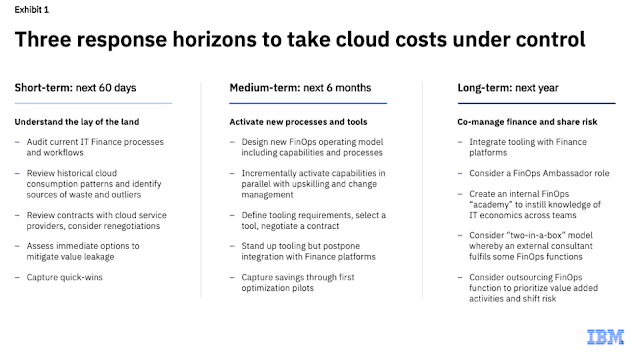
When designing and implementing such an effort, it’s useful to think about three main blocks of activity across short, medium and long-term horizons.
IBM Exam, IBM Exam Study, IBM Career, IBM Skills, IBM Jobs, IBM Tutorial and Materials, IBM Certification

Short-term actions (next 60 days)


The first step for any organization is to get a comprehensive understanding of the real underlying costs of its IT operations — not just cloud, but the entire technology plant. A major life sciences company, for example, employs a dedicated data scientist to conduct a thorough analysis of the output from cloud-native billing tools. Using this data, it creates a granular, component-by-component view of the likely spend outliers or “bad behaviors” of the development teams.

The organization should also embed a third-party observer (internal or external) into the IT finance, procurement and development teams to map out the processes and flaws in existing workflows. Leaders can use this information to come up with a future IT finance strategy, vendor management strategy and optimization opportunities. They can also identify opportunities to rapidly reduce costs through quick changes in how cloud environments operate (e.g., automatically shutting down resources after they are idle for a certain period).

Medium-term actions (next 6 months)


After this orientation, leaders can double down on efforts to redesign and rebuild the internal workflows and processes around financial management — how costs are tracked, aggregated, alerted and reported out to business owners, development teams and senior leadership. This cannot be achieved without building new capabilities outside the conventional playbook. For some companies, it may be enabling chargeback. For others, it may be establishing a way to reconcile budgets with the master budget. Most importantly, it will require building a FinOps “muscle” and knowledge of cloud economics throughout the IT team.

By building out new capabilities and processes, CIOs can deliver step-change improvements in IT and finance operations. One IBM banking client redesigned its entire IT finance function to activate 20 new cloud FinOps capabilities and take advantage of extreme automation, AI/ML and advanced analytics. With the help of this solution, the bank increased cost efficiency of cloud deployments by 30% without affecting the function of applications and systems.

Upskilling everyone in IT to be FinOps-conversant is key. A biomedical research organization, for instance, has established a FinOps academy and dedicated resources for continuous education on IT economics to train developers, product owners and business and financial analysts.

Companies can also take advantage of the modern FinOps and observability tools to further enhance cost controls and establish a “single pane of glass” management console. But the redesigning process always comes first. Tools just reduce reliance on disparate and convoluted cloud-native billing systems.

Longer-term actions (next year or two years)


Over the longer term, companies may want to focus on what’s important: building new products and innovating with the business, not managing IT finance processes and coordination with many engineering teams. This process begins with a re-evaluation of in-house FinOps versus managed-services decisions.

Rapidly rising cloud deployments, the size of the cloud bill (which can reach billions of rows), everchanging complexity and pricing models for services across cloud providers are already driving a shift in how the new IT finance playbook is implemented. Some companies seek to maintain some control and oversight of the process and choose a two-in-a-box model, with third-party FinOps experts embedded in teams. Others outsource the FinOps function to technology consultants who can build the bridge between IT, finance, and procurement, linking with existing systems such as SAP and Workday.

Maximize cloud value while avoiding costs


Cloud is here to stay, but companies must maintain profit margins, stay competitive in established markets and execute operational efficiencies. The CIO is at the heart of this. A new generation CIO will decisively change the way teams create new cloud solutions with IT economics in mind. As IT financial management becomes ingrained into all aspects of the workplace, it will be in the CIO’s best interest to maintain profit margins and reduce the total cost of revenue and total cost of goods sold.

Cost savings start with the right workload placement, and the conversation around hybrid cloud is picking up speed as it allows CIOs to moderate costs while delivering the required performance. Accurate cost models, integrated tools and observability across the technology plant give product, engineering, procurement and finance teams the methodology to realize possible savings and capture the business value expected by the CEO, the board and Wall Street.

Source: ibm.com